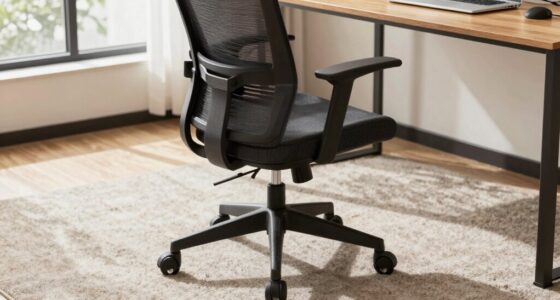
Choosing an ergonomic office chair often comes down to a practical tension: stay cooler through long work sessions, or get a softer, more cushioned seat. Mesh ergonomic chairs use a woven back, and sometimes a mesh seat, to let air circulate. Upholstered chairs cover a padded frame in fabric or similar material, giving the chair a more traditional feel. Neither category guarantees good posture or lasting comfort; adjustability, fit and build quality matter more than the surface material alone.

Get comfort and recovery gear delivered free with Prime
- Fast, free delivery on millions of items
- Prime Video, Amazon Music and more included
- Member-only deals all year

ELABEST X100 Ergonomic Mesh Office Chair with Footrest
- ✔ Lumbar support: 3D adjustable; 1.6 in depth, 2 in height, 15° rotation
- ✔ Armrests: 5D adjustable and flip-up
- ✔ Headrest: 3D adjustable, 28 cm

CYKOV Ergonomic Mesh Office Chair with Footrest
- ✔ Model: CY59B
- ✔ Capacity: Conflicting listing: 300 pounds in specifications; 350 pounds in title and description
- ✔ Recline: 90°–135°

Monhey Ergonomic Mesh Office Chair with Lumbar Support, Adjustable Height and Flip-Up Arms, Khaki
- ✔ Brand and model: Monhey 6969SB
- ✔ Color: Khaki
- ✔ Back material: Breathable mesh
Mesh is usually the stronger choice for warm rooms, extended sitting and people who prefer a responsive seat with less fabric to maintain. Upholstery suits people who want a plush sitting surface, a warmer feel or more color and texture options. The right choice depends on how the chair fits your body and workday, but airflow versus cushioning is the clearest starting point.
At a Glance
| Criteria | Mesh ergonomic office chairs | Upholstered ergonomic office chairs | Winner |
|---|---|---|---|
| Airflow and temperature | Usually more breathable, especially with a mesh seat | Retains more warmth, particularly with thick padding | A |
| Seat feel and cushioning | Firmer, more responsive feel; varies by mesh tension and seat design | Softer and more cushioned, with feel shaped by foam and fabric | B |
| Support and adjustability | Depends on the model; mesh material alone does not provide better ergonomics | Depends on the model; padding and upholstery do not guarantee better support | Depends |
| Cleaning and upkeep | Generally easy to wipe or vacuum; less fabric to trap spills | Fabric may hold stains and odors; care needs vary by material | A |
| Durability and wear | Quality mesh can hold up well, though it can stretch, snag or wear | Foam may compress and fabric may wear, depending on construction and use | Depends |
| Style and room fit | A lighter, more technical appearance with fewer upholstery choices | More fabric colors and textures; can feel more at home in a living space | B |
| Value | Often good for warm workspaces and low-fuss upkeep | Worth the extra cost when cushioning or appearance matters to the buyer | Depends |
ELABEST X100 Ergonomic Mesh Office Chair with Footrest
The ELABEST X100 earns our top position because its adjustments reach the parts of the chair that most affect fit: lumbar depth, height, and rotation; headrest position; armrests; and recline. Its lumbar support can move 1.6 inches in depth and 2 inches in height, with 15° of rotation. That gives us more scope to place support where it is useful than the Monhey’s adjustable lumbar support, whose adjustment range is not specified. The 5D arms can be repositioned and flipped up, offering more setup options than the CYKOV’s adjustable armrests as described.It also includes an extendable two-position footrest and three-stage recline, so it can accommodate a change of posture during a break. The tradeoff is that there are many settings to learn: buyers who want to sit down and make only a couple of adjustments may find the CYKOV or Monhey easier to approach. At 300 pounds listed capacity, it also has a stated limit rather than an unclear one, though buyers should still confirm that this suits their needs. Its BIFMA certification and five-year warranty are useful differentiators in this group; comparable certification is not specified for the other two chairs.
Pros:
- 3D lumbar adjustment spans depth, height, and rotation.
- 5D flip-up arms and a 3D adjustable headrest allow detailed positioning.
- Extendable footrest has two angle positions; back uses a three-stage recline.
- BIFMA certification, 300 lb capacity, and a five-year warranty are specified.
Cons:
- The number of adjustments may take time to configure to personal preference.
- The listed 300 lb capacity may not suit every buyer.
- A footrest adds a feature that may go unused by buyers who sit upright throughout the day.
Best for: People who want to tune lumbar, headrest, and armrest positions around a home-office setup and value a footrest for occasional reclined breaks.
Not ideal for: Buyers who prefer a simple chair with few adjustments, do not need a footrest, or need a listed capacity above 300 pounds.
Bottom line: Choose the ELABEST X100 when detailed fit adjustments matter more than a quick, simple setup.
“Choose the ELABEST X100 when detailed fit adjustments matter more than a quick, simple setup.”
CYKOV Ergonomic Mesh Office Chair with Footrest
For buyers who want to shift from upright work to a more relaxed posture, the CYKOV CY59B has the most generous specified recline in this trio: 90° to 135°, paired with a retractable footrest. That is a wider stated range than the Monhey’s 90°–125° recline and gives it a clearer relaxation focus. The headrest swivels 60° and adjusts 4.72 inches, while the lumbar support moves in two directions. Those dimensions provide more concrete fit information than Monhey’s listing, although ELABEST still offers more adjustment axes for lumbar support and armrests.The mesh back is described as breathable, and the package includes a clothes hanger and a five-year structural warranty. These touches make it a feature-rich option for a combined office and leisure setup. Its main drawback is an important specification conflict: the title and description state a 350-pound capacity, while the specification field says 300 pounds. We cannot resolve that discrepancy from the supplied information, so anyone whose choice depends on capacity should verify the limit before buying. The included footrest also makes this a less compelling fit for buyers who want a strictly upright work chair or have limited space to extend it.
Pros:
- 90°–135° recline provides the broadest stated range in this group.
- Retractable footrest supports a more reclined position during breaks.
- Headrest and two-way lumbar support include specified adjustment dimensions.
- Five-year structural warranty and included clothes hanger are listed.
Cons:
- Capacity conflicts between the 300-pound specification and 350-pound title and description.
- The footrest-oriented design may be unnecessary for an upright-only work routine.
- Its lumbar support is described with fewer adjustment dimensions than ELABEST’s 3D system.
Best for: People who divide their chair time between computer work and reclined breaks and want a footrest, adjustable headrest, and stated structural warranty.
Not ideal for: Buyers who need a clearly verified weight limit, want the most precisely adjustable lumbar and armrest setup, or have little room for a retractable footrest.
Bottom line: Pick the CYKOV when recline and a retractable footrest are priorities, after confirming its capacity with the seller.
“Pick the CYKOV when recline and a retractable footrest are priorities, after confirming its capacity with the seller.”
Monhey Ergonomic Mesh Office Chair with Lumbar Support, Adjustable Height and Flip-Up Arms, Khaki
The Monhey 6969SB covers the essentials for an everyday desk chair without the more elaborate arrangement of adjustment points on the ELABEST. Its breathable mesh back and adjustable lumbar support address two basic comfort considerations, while the padded seat gives it a more conventional office-chair feel. The recline locks between 90° and 125°, so it offers a modest range for changing posture, though the CYKOV reaches a more reclined 135° and adds a footrest. Buyers who do not need those extras may prefer Monhey’s less feature-heavy setup.Flip-up arms are useful when we need to move closer to a desk or clear space beside the chair. A 360° swivel base and quiet rolling wheels support ordinary movement around a workstation, and hardware and instructions are included for assembly. The listing does not provide the detailed lumbar, headrest, or seat-height ranges that make the ELABEST easier to assess for fit. There is also a material capacity discrepancy: product information says 300 pounds while the description says 330 pounds. That makes this a weaker choice for anyone relying on the stated limit; confirm it before purchase. No warranty detail is supplied here, another point to check if long-term coverage matters.
Pros:
- Adjustable lumbar support and breathable mesh back provide the core support features.
- 90°–125° recline locks at the selected position.
- Flip-up arms can help the chair fit beneath a desk or open up workspace.
- 360° swivel base, quiet rolling wheels, padded seat, and assembly instructions are listed.
Cons:
- Capacity conflicts between 300 pounds in product information and 330 pounds in the description.
- No warranty or detailed adjustment ranges are provided in the supplied specifications.
- Its 125° maximum recline is more limited than CYKOV’s 135° range.
Best for: Buyers seeking a relatively straightforward mesh chair with adjustable lumbar support, a locking recline, and arms that flip up out of the way.
Not ideal for: People who want a footrest, detailed headrest and armrest adjustment, a verified capacity, or warranty information before choosing.
Bottom line: Choose Monhey for core ergonomic features and flip-up arms, provided its capacity and warranty details meet your requirements.
“Choose Monhey for core ergonomic features and flip-up arms, provided its capacity and warranty details meet your requirements.”
As an Amazon Associate we earn from qualifying purchases.
Key Differences
The most noticeable difference is temperature. Mesh allows more air to pass through the back, and a mesh seat can reduce heat buildup under the body. That can make a difference in a warm office or during long stretches without breaks. Upholstery holds more warmth, but some people prefer that coziness, especially in a cool room. Mesh is not automatically cooler if only the back is mesh and the seat is heavily padded.
Comfort is more personal than the material labels suggest. Upholstery often feels softer when first sitting down, while mesh tends to feel firmer and more supportive through tension. But foam density, seat shape, adjustability and individual fit determine whether a chair stays comfortable over a full day. A well-fitting chair in either category can outperform a poorly designed one.
Upkeep and appearance also pull in different directions. Mesh is often simpler to clean and resists the look of everyday fabric wear, though it can snag or stretch. Upholstered chairs offer more colors and a familiar, padded look, but fabric can collect dust, stains and odors, and foam can flatten with age. Compare the chair’s adjustment range and return policy before paying a premium for either material.
Detailed Comparison
Airflow and temperature (Mesh ergonomic office chairs wins — moderate)
Mesh wins by a moderate margin for people who run warm or work in rooms without reliable cooling. Its open weave lets heat escape, particularly when both the back and seat are mesh. An upholstered back and padded seat usually retain more warmth. In a cool room, that extra insulation may feel pleasant, so temperature preference can narrow the gap.
Seat feel and cushioning (Upholstered ergonomic office chairs wins — moderate)
Upholstery wins for immediate softness, but the overall result depends on fit. Foam padding gives many upholstered chairs a cushier first impression, a moderate difference for people who dislike firm seats. Mesh offers a tauter feel that some users find more consistent over time. Seat depth, edge shape and foam or mesh quality matter more than the category name.
Support and adjustability (major difference)
Neither category wins by material alone. This is a major buying criterion, but the difference between chair models outweighs the difference between mesh and upholstery. Lumbar adjustment, seat height and depth, recline control and armrest positioning determine whether the chair can fit the user. Choose the better-adjusted chair, even if its surface is not your first preference.
Cleaning and upkeep (Mesh ergonomic office chairs wins — moderate)
Mesh usually wins by a moderate margin. It has less padded fabric to absorb spills and odors, and routine dust removal is often straightforward. Upholstery may need more careful spot cleaning and can show stains, especially in light colors. Mesh still needs cleaning and can be harder to repair if a thread snags or the weave tears.
Durability and wear (minor difference)
This is a tie at category level. The gap is minor because both materials can last or fail depending on construction. Mesh can stretch, fray or snag; upholstery can abrade, stain, and lose padding as foam compresses. Check warranty coverage, frame quality and replacement-part availability rather than assuming one surface lasts longer.
Style and room fit (Upholstered ergonomic office chairs wins — moderate)
Upholstery has a moderate advantage for buyers who want color, texture or a softer look that blends into a home office or shared living space. Mesh often reads as more technical and is available in fewer finishes. If appearance matters, check fabric swatches and dimensions: a chair that looks good online can still dominate a small desk area.
Value (minor difference)
Neither is automatically the better value. The difference is minor until a specific feature matters to the buyer. Paying more for mesh can make sense for heat management and low-fuss care; paying more for upholstery can be worthwhile for better cushioning or a finish that suits the room. Spend on fit and useful adjustments first, then on the preferred surface.
Mesh ergonomic office chairs: Pros and Cons
Pros:
- More airflow, especially in a fully mesh design
- Often simple to clean and maintain
- Firmer feel may suit people who prefer a responsive seat
Cons:
- Can feel too firm to people who prefer plush padding
- Weave may snag or stretch over time
- Often has a more technical look and fewer finish choices
Upholstered ergonomic office chairs: Pros and Cons
Pros:
- Typically feels softer and more cushioned
- More colors and fabric textures are commonly available
- Can feel warmer and more inviting in a cool room
Cons:
- May retain heat during long sessions
- Fabric can collect spills, dust and odors
- Padding can compress with use
Who Should Choose What
Choose Mesh ergonomic office chairs if:
- You work in a warm room or tend to overheat while sitting.
- You want a chair that is relatively simple to clean.
- You prefer a firmer, more responsive feel and like a modern office look.
Choose Upholstered ergonomic office chairs if:
- You prefer a cushioned seat and a softer first impression.
- Your office is cool, or you like a warmer sitting surface.
- You want upholstery colors and textures that complement your room.
Skip both if: Skip both until you can compare fit if neither type offers suitable seat dimensions, adjustable lumbar support and armrests, or a trial or return option.
Value for Money
Paying more is worthwhile when the added cost buys an improvement you will notice every workday: a better fit, useful adjustments, durable construction or a return period that lets you judge comfort. Mesh can justify a premium for someone who gets uncomfortably warm or wants less fabric upkeep. Upholstery can justify one when its cushioning and finish meet a clear comfort or room-design preference. If the more expensive chair mainly adds a material label or appearance, the price gap may not be worthwhile. Compare warranty terms and replacement parts along with the upfront cost.
Final Verdict
For a typical long workday in a warm room, choose a well-fitted mesh chair, ideally one with a mesh seat as well as back. It offers the clearest practical benefit: airflow with relatively straightforward upkeep. Choose an upholstered chair if a softer, warmer seat is a priority and you are willing to clean fabric and monitor padding wear. The biggest deciding factor is how the chair feels and adjusts to your body, not whether its surface is mesh or fabric. When models are similarly adjustable and priced, let room temperature and seat preference decide.
Frequently Asked Questions
Are mesh or upholstered chairs better for sitting all day?
Neither material guarantees all-day comfort. A chair that fits your height and body, supports your lower back and lets you change posture is a better starting point. Mesh may feel cooler over long sessions; upholstery may feel softer. If possible, try the chair or buy from a seller with a clear return policy.
Are mesh office chairs cooler than upholstered chairs?
Usually, particularly when the seat and back are both mesh. A mesh back paired with a thick padded seat will not feel as airy as a fully mesh design. Upholstery tends to retain more warmth, which may suit a cool office.
Does mesh provide better ergonomic support?
No material is inherently more ergonomic. Support comes from the chair’s shape and adjustments, including seat depth, lumbar position, recline and armrests. Compare those features and check that they suit your body.
Is it worth paying more for an ergonomic office chair?
It can be, if the higher price buys a better fit, meaningful adjustments, a durable frame or a useful warranty. Pay more for mesh if airflow matters to you, or for upholstery if cushioning and appearance matter. A costly chair without the right dimensions or adjustments may still be a poor fit.
Halloween Picks
halloween
As an affiliate, we earn on qualifying purchases.