
TL;DR

Get comfort and recovery gear delivered free with Prime
- Fast, free delivery on millions of items
- Prime Video, Amazon Music and more included
- Member-only deals all year
Fit&Well published a personal trainer’s 10-minute, equipment-free circuit for clients over 60, using chair squats, wall push-ups and standing knee-to-elbow movements. The routine calls for three rounds of 10 repetitions per exercise, with 10 per side for the knee-to-elbow move; the trainer recommends doing it three to four times a week and modifying movements for support and comfort.
Fit&Well has published an equipment-free, 10-minute home workout that a personal trainer says they give clients over 60 to practice between sessions. The three-move circuit combines chair squats, wall push-ups and standing knee-to-elbow crunches, with the report advising readers to work at a manageable pace and use support when needed.
The report describes a circuit of three exercises. Readers are instructed to complete 10 repetitions of each movement, then repeat the sequence until they have done three rounds. The knee-to-elbow movement is performed for 10 repetitions on each side. With brief rests, three rounds are expected to take about 10 minutes, though the trainer says it is acceptable for beginners to take longer.
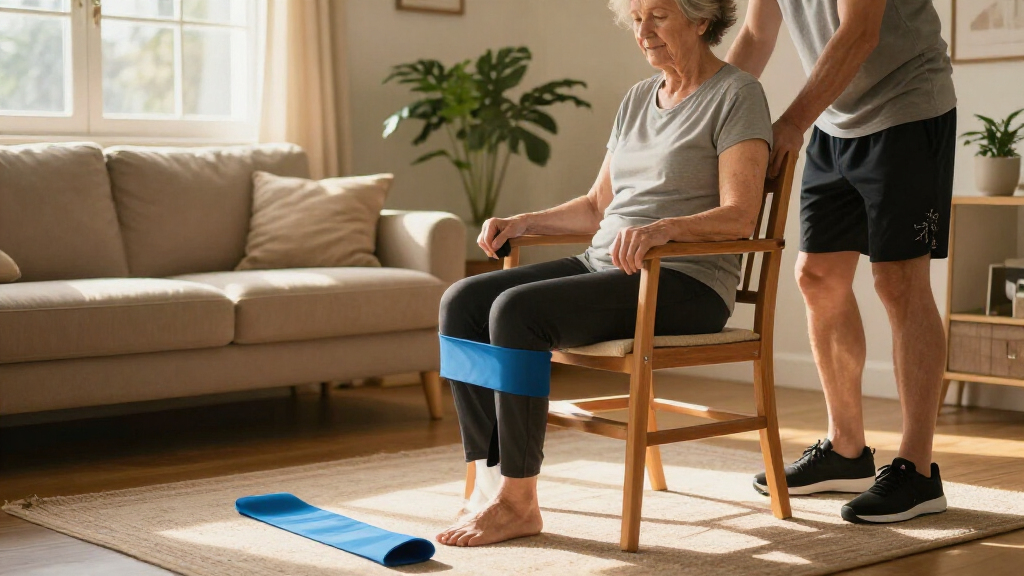
The exercises use body weight and a chair or wall. For chair squats, stand in front of a chair, bend at the hips and knees to tap the seat, then stand. The report says people who find the tap difficult can sit down fully before standing, and may hold a wall or other solid structure for support. Wall push-ups are done facing a wall, lowering the chest toward it by bending the elbows before pushing back.
For the final move, stand with feet hip-width apart and alternate lifting a knee toward the opposite elbow. The trainer advises moving only through a comfortable range and says the elbow does not have to touch the knee. People with balance concerns can do one side at a time while holding a wall or chair, according to the report. The trainer recommends the workout three to four times per week, while cautioning that incorrect form can cause pain or injury.
A Short Routine for Home Practice
The routine offers a simple way for older adults to practice basic strength movements without gym equipment or a long session. Its use of a chair and wall also gives readers options to adjust the exercises: sitting fully before standing, moving closer to the wall for an easier push-up, or holding a stable surface during the balance-demanding movement.
That flexibility is relevant because the report does not present the routine as suitable for every person or every ability level. It is a trainer’s suggested workout for clients, not evidence that the same sequence is safe or appropriate for all adults over 60. The source says form matters and recommends getting instruction from a personal trainer, particularly before advancing the exercises.
Products Worth Considering

Blueair Blue Pure 511i Max Air Purifier for Home and Bedroom

Blueair Blue Pure 211i Max Smart Air Purifier for Large Rooms

Dyson V8 Cordless Vacuum
As an affiliate, we earn on qualifying purchases.
Three Moves, Three Rounds
The report frames the workout as something clients can do between personal-training sessions. Its stated aim is a short, full-body routine covering the lower body, upper body and core. The movements are a chair squat, a wall push-up and a standing knee-to-elbow crunch; no weights or other exercise equipment are specified.
The trainer’s timing estimate depends on completing three rounds with only brief rests. The article allows for a longer workout while someone is learning the movements and says practice may reduce the amount of rest needed. It also suggests splitting activity across the day, though it does not provide a separate assessment of how that approach applies to an individual’s health or fitness needs.
Individual Ability and Safety
The supplied report does not identify the trainer by name or provide details about their qualifications, and it does not cite clinical research evaluating this particular circuit. It also does not specify how readers should adapt the routine for particular diagnoses, injuries, medications or mobility limitations. The recommendation of three to four sessions weekly is the trainer’s guidance in the article, not an individualized prescription.
The source says the exercises could cause pain or injury if done incorrectly, but does not define which readers should avoid them or give a screening process. Anyone uncertain about whether the movements are appropriate for them should seek guidance from a qualified health professional or trainer before starting. Stop if an exercise causes pain, and use a stable support rather than relying on balance alone where needed.
Progress at a Manageable Pace
The article advises readers to begin with brief rests and allow more than 10 minutes if necessary, then continue practicing as they become familiar with the movements. It suggests gradually reducing rest only when the exercises remain manageable and calls for professional instruction before increasing difficulty. No follow-up study, additional workout plan or further announcement is included in the supplied material.
Key Questions
What exercises are in the workout?
The circuit includes chair squats, wall push-ups and standing knee-to-elbow crunches. The report says it requires no exercise equipment, though a chair and wall are used as supports or exercise surfaces.
How many repetitions and rounds does it call for?
Do 10 repetitions of each move, then repeat the sequence for three rounds. For the knee-to-elbow exercise, the instruction is 10 repetitions per side.
How often does the trainer recommend doing it?
The trainer recommends three to four times per week. That is the report’s general guidance, not a personalized exercise plan.
What if I have balance concerns or cannot complete a movement?
The report suggests holding a wall or chair during the standing knee-to-elbow move and working within a comfortable range. For chair squats, it says readers can sit fully before standing; anyone unsure about safe form should seek qualified guidance.
Source: fitandwell.com