TL;DR

Get comfort and recovery gear delivered free with Prime
- Fast, free delivery on millions of items
- Prime Video, Amazon Music and more included
- Member-only deals all year
Fit&Well’s training report outlines a four-move kettlebell circuit: goblet squats, goblet cleans, overhead presses and halos. It recommends learning basic squat, press and deadlift technique first, using a manageable weight and stopping if form breaks down.
Fit&Well has published a trainer’s four-move kettlebell circuit for beginners looking to work several parts of the body in one session: goblet squats, goblet cleans, overhead presses and halos. The report says users should already know how to squat, overhead press and deadlift with proper form before trying the routine, and should stop if their technique begins to deteriorate.
The trainer says the exercises are introduced to clients after they have been working together for a while, as a new challenge. The report describes kettlebells as a way to build full-body strength and says their uneven weight distribution gives the forearms and muscles around the wrists a different stimulus. These are the trainer’s recommendations, not findings from a comparative study in the source.
The suggested format is a circuit of four exercises: complete one set of each move in order, then repeat the sequence for two to four rounds, depending on available time and fitness. The report gives a target of 8–12 repetitions for each move, except halos, for which it recommends 8–12 repetitions in each direction. It does not specify rest periods or a particular kettlebell weight.
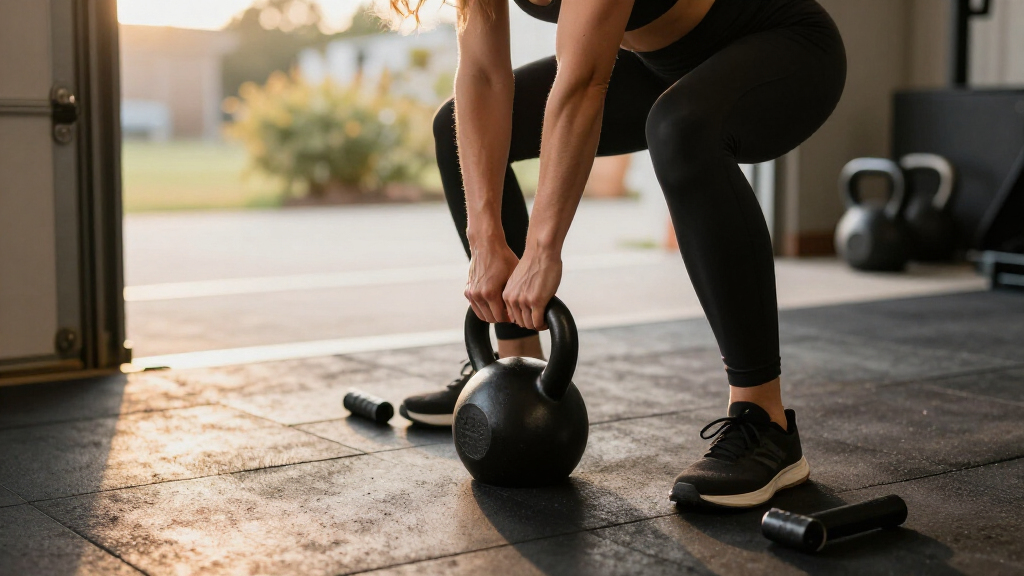
For a goblet squat, hold the kettlebell at the chest, brace the core, sit the hips back and bend the knees, then stand by pushing through the feet. The goblet clean starts with the bell on the floor; the lifter hinges, grips the handle with both hands, drives the hips forward and catches the bell at the chest. The overhead press moves the bell from chest height to overhead and back, while the halo circles it around the head in both directions. The trainer advises keeping each movement controlled.
A Four-Move Strength Circuit
The routine gives beginners a defined sequence and repetition range rather than a list of unrelated exercises. It combines a squat pattern, a hip-driven lift, an overhead press and a controlled movement around the head, offering a simple structure for a strength session without requiring multiple pieces of equipment.
The safety guidance is central to the report’s recommendation. A kettlebell clean involves coordinating a hip hinge and catching the weight, while pressing and halo movements require control around the shoulders and torso. The trainer’s advice to begin only after learning foundational movement patterns, select a lighter bell if form slips and stop when technique breaks down is a practical limit on how the circuit should be used. The article does not claim that the sequence is suitable for every person or that it produces a particular outcome.
As an affiliate, we earn on qualifying purchases.
The Trainer’s Starting Point
The original Fit&Well report presents the circuit from the perspective of a personal trainer who adds kettlebell work after spending time with a client. It is not described as a beginner’s first-ever strength session: the trainer says clients should be able to squat, overhead press and deadlift correctly before attempting it.
The suggested movements have distinct technique demands. The squat and press use the bell at the chest or overhead; the clean takes it from the floor to the chest using hip-generated momentum; and the halo circles it around the head. The report’s cues include avoiding an excessively forward-leaning torso in squats, keeping the back from rounding or arching during cleans, and keeping the ribs drawn in during presses.
As an affiliate, we earn on qualifying purchases.
Weight and Rest Are Unspecified
The report does not name a recommended kettlebell weight, set rest intervals, or explain how to progress the load over time. It also does not provide study results comparing this circuit with other workouts, or evidence that the routine is appropriate for people with injuries, pain or particular health conditions.
The suggested repetitions and two-to-four-round range are presented as the trainer’s guidance. Readers should not treat them as a personalized program: the source does not assess individual strength, mobility or experience. It is also not clear when the report was published, as the supplied source material gives no date.
As an affiliate, we earn on qualifying purchases.
Start Light and Check Technique
Anyone using the circuit should first confirm they can perform the prerequisite squat, press and deadlift patterns with control. Begin with a manageable kettlebell and prioritize technique over reaching the upper end of the repetition range or completing four rounds. For the squat, reduce the load if the torso leans too far forward; during cleans, avoid rounding or arching the back; in presses, keep the bell aligned over the body; and during halos, keep the elbows close and avoid relying on momentum.
The report gives no follow-up training schedule or progression plan. People who are new to strength training or unsure about form can seek instruction from a qualified trainer. Those with existing health concerns or injuries should get professional guidance before starting a new routine.
As an affiliate, we earn on qualifying purchases.
Key Questions
Which four kettlebell exercises are recommended?
The Fit&Well report recommends goblet squats, goblet cleans, overhead presses and halos, performed as a circuit.
How many repetitions and rounds does the report suggest?
It suggests 8–12 repetitions for each exercise and two to four rounds. For halos, the target is 8–12 repetitions in each direction. The report does not specify rest periods.
What should beginners know before trying the circuit?
The trainer says users should already know how to squat, overhead press and deadlift with proper form. The report also advises stopping if technique begins to break down.
Does the report give a recommended kettlebell weight?
No. It does not prescribe a weight. Its guidance is to use a lighter kettlebell if form is compromised, and it does not provide an individualized load or progression plan.
Source: rss
Halloween Picks
halloween
As an affiliate, we earn on qualifying purchases.