TL;DR

Get comfort and recovery gear delivered free with Prime
- Fast, free delivery on millions of items
- Prime Video, Amazon Music and more included
- Member-only deals all year
A Fit&Well report features a trainer who includes three coordination exercises in sessions with older adults: opposite arm-and-knee raises, side steps with an opposite-arm reach, and a ball-throwing drill. Each can be adjusted for seated practice or different mobility levels, but the report does not provide new research or evidence that these specific drills prevent falls or extend life.
Fit&Well has published a trainer’s account of three coordination exercises she uses with older adults: an opposite arm-and-knee raise, a side step paired with an opposite-arm reach, and a ball-catching drill. The exercises can be adapted for seated practice, offering options for people with different mobility levels, though the report does not establish that these particular moves prevent falls or extend lifespan.
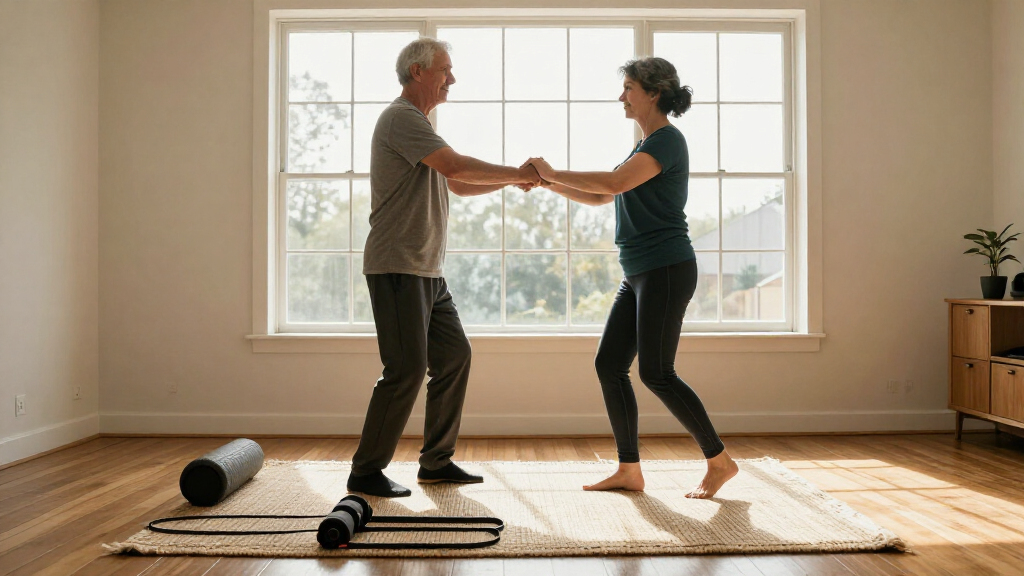
The trainer says she includes coordination work in chair-based yoga classes and personal-training sessions with older adults. Her stated aim is to practise coordinating different limbs and build the mind-to-muscle connection. She says clients perform the movements standing when appropriate, sometimes alongside balance exercises, or use seated alternatives.
For the first drill, stand with feet about hip-width apart and arms extended at shoulder height. Raise one knee while bringing the opposite arm forward, then return to the starting position and alternate sides. The report suggests five to six repetitions per side. The seated version is a slow march with the opposite arm raised in front or overhead.
The second drill pairs a side step with a reach from the opposite arm. Step to one side, reach the other arm forward, return, and switch sides; a side lunge is optional. The suggested count is five to six repetitions on each side. Seated, the movement becomes a side step-out with the opposite arm opening to the side. For the third drill, the participant throws a ball underhand against a wall and catches it while balancing on one foot. The report recommends five to 10 throws, with easier options including standing on both feet or sitting down.
Coordination in Everyday Movement
The exercises combine movement in different directions with attention and, in one drill, catching a moving object. The trainer says that kind of practice is intended to help clients feel more agile and confident in everyday situations, such as moving around people on a bus or handling tasks at home. Those are the trainer’s reported aims and observations, not measured outcomes from a clinical trial presented in the article.
The practical point is adaptability: the routines can be performed seated, and the ball drill can be simplified by using both feet for support. This gives instructors and participants ways to adjust the challenge to current mobility. Readers should not treat the routines as a substitute for individual advice, especially if they have balance problems, pain, or a health condition that affects movement.
Products Worth Considering

Dyson Big Ball Multi Floor Canister Vacuum, Yellow

Dyson Ball Animal 3 Corded Upright Vacuum

Bose TV Speaker (2nd Gen) Compact Soundbar with Bluetooth and HDMI Connectivity
As an affiliate, we earn on qualifying purchases.
How the Report Frames Training
The report places coordination alongside strength training, which it describes as a familiar part of exercise advice for aging well. Its focus is the trainer’s view that coordination deserves a place in sessions for older adults, rather than a new exercise guideline or a formal program tested by the publication.
Fit&Well refers to a 2019 review of balance and coordination exercises in older adults. According to the source material, that review found improvements in cognitive processes such as spatial awareness, as well as postural control and stability in distracting environments. The supplied report does not give the review’s title, sample sizes, or detailed findings, so it is not possible here to assess how closely its results apply to the three specific exercises.
“I always incorporate coordination training into my chair-based yoga classes and personal training sessions with older adults.”
— The trainer featured in Fit&Well
Evidence and Safety Details
The report does not identify the trainer by name in the supplied material or provide data on how often clients perform the exercises, how long they have trained, or how their outcomes were measured. It also does not show that these three drills specifically improve cognition, prevent falls, or increase longevity. The cited 2019 review is described in broad terms, without enough bibliographic or methodological detail to evaluate its conclusions here.
Individual safety needs are also not specified. Standing on one leg or throwing a ball can be challenging for someone with limited balance. The article offers seated and two-footed modifications, but does not provide a screening process or personalized instructions. Anyone unsure whether an exercise is appropriate can ask a qualified health or exercise professional for guidance.
Adapt the Drills to Ability
The report presents the exercises as options for use in training, not as a prescribed schedule. It gives repetition ranges but no weekly frequency, progression plan, or benchmark for deciding when to move from seated to standing practice. Participants and instructors would need to choose a version suited to the person’s ability and surroundings.
Further reporting could clarify the trainer’s qualifications, how clients respond over time, and the exact 2019 review cited. Until then, the source supports a narrow takeaway: the trainer uses adaptable coordination drills with older adults, while the effects of these specific exercises remain unmeasured in the report.
Key Questions
Which coordination exercises does the trainer recommend?
The report describes an opposite arm-and-knee raise, a side step with an opposite-arm reach, and throwing and catching a ball while balancing.
Can the exercises be done while seated?
Yes. The report gives seated alternatives for all three: a controlled march with the opposite arm raised, seated side step-outs with an arm opening, and ball practice while seated.
Does the report show that these exercises prevent falls?
No. It says a 2019 review found benefits from balance and coordination exercises in older adults, but it does not show that these three drills prevent falls or provide trial results for them.
How many repetitions does the report suggest?
It suggests five to six repetitions per side for each of the first two movements and five to 10 throws for the ball drill. It does not prescribe a weekly schedule.
Source: rss