
TL;DR

Get comfort and recovery gear delivered free with Prime
- Fast, free delivery on millions of items
- Prime Video, Amazon Music and more included
- Member-only deals all year
Fit&Well published a four-exercise, Pilates-inspired weights routine attributed to instructor Victoria Repa. It combines squats, lunges, a weighted bridge and side-lying leg lifts, with guidance to begin with one round and use a load that leaves two or three controlled repetitions in reserve. The source presents it as a workout suggestion, not as evidence that this specific routine improves alignment or produces a particular health outcome.
Fit&Well has published a four-exercise, weights-based workout that combines familiar strength movements with Pilates-inspired cues for breathing, posture and controlled movement. The routine, shared by Pilates instructor Victoria Repa, is presented for beginners who want to add resistance while keeping the exercises low-impact; the source does not report independent testing or measured results for the workout.
The routine consists of a weighted squat, standing lunge, weighted Pilates bridge and side-lying leg lift with an ankle weight. The instructions call for 8–12 squats, 6–8 lunges on each side, 10–12 bridges and 8–10 leg lifts on each side. Repa recommends resting 45–60 seconds between exercises.
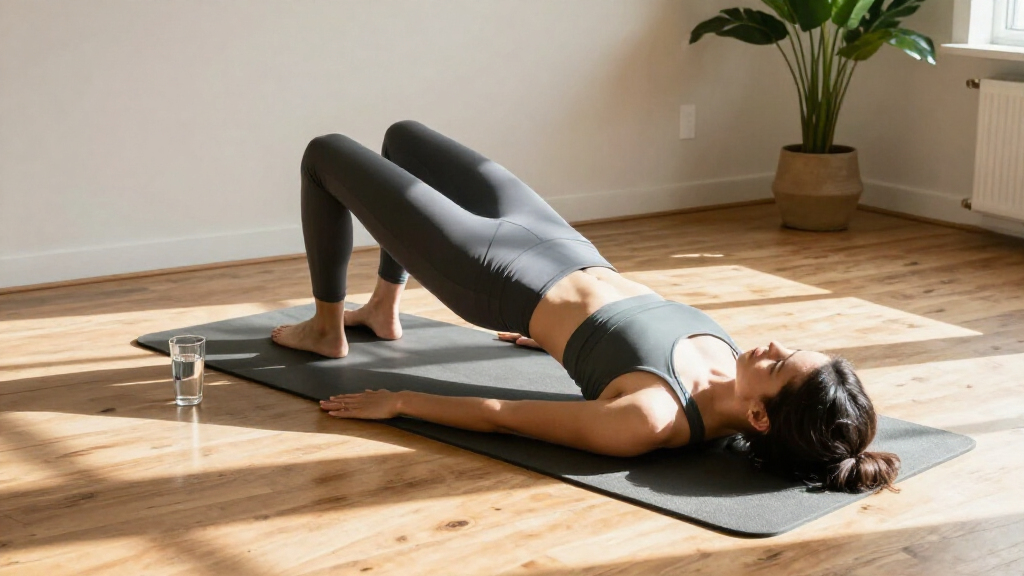
For the squat, participants hold dumbbells at their sides, lower by bending at the hips and knees, and keep their feet grounded with knees tracking toward the toes. In the lunge, a step-back stance is used and the movement is performed with light dumbbells. The bridge is done lying on the back, with a dumbbell held across the hips and a folded towel beneath it for cushioning. The final exercise uses a light ankle weight while lying on one side; the raised leg stays aligned with the body and the toes point forward.
Repa advises starting with one round and trying two once the movements feel familiar. She says to choose resistance that would still allow two or three controlled repetitions beyond the planned set. That is guidance from the instructor, not a personalized prescription; the article does not set out screening criteria or modifications for every reader.
Adding Resistance to Pilates Principles
The routine offers readers a practical example of how resistance exercises can be performed with deliberate pacing and alignment cues, rather than treating load and movement control as separate goals. Its four exercises cover the hips and legs through squats, lunges and bridges, with a side-lying leg lift adding a unilateral movement.
Repa says weights can make muscles work harder while attention to breathing and control remains central. The source also describes weight training as a way to support muscle mass and bone health, and Pilates as an approach associated with posture, mobility and alignment. These are general explanations, not findings from a study of this particular sequence. Readers should not interpret the workout’s title as proof that it will correct alignment or deliver a specific health benefit.
For people deciding whether to try the routine, the clearest practical value is its defined exercise order, repetition ranges and rest periods. The suggested light starting load and single-round option give beginners a way to scale the session, although individual ability and any existing injuries or health conditions may affect suitability.
Products Worth Considering

Ring Alarm Pro 14-Piece Home Security Kit with Built-In eero Wi-Fi 6 Router

Dyson Car+Boat Cordless Handheld Vacuum

Google Nest Learning Thermostat (4th Gen) with Nest Temperature Sensor (2nd Gen), Obsidian
As an affiliate, we earn on qualifying purchases.
From Mat Work to Weighted Moves
The Fit&Well report contrasts Pilates’ traditional mat practice with contemporary workouts that incorporate weights and a wider range of movements. It says the original form of Pilates revolves around 34 mat movements, while newer approaches may apply Pilates principles to other exercises and add resistance. The article does not provide a historical account or explain how the 34-movement figure was established.
Repa describes adding weights as a possible next step for people who already enjoy Pilates and feel ready for more challenge. The exercises in her routine are recognizable resistance-training movements, but the report’s emphasis is on maintaining breathing, alignment and controlled execution while performing them. No equipment beyond dumbbells, a light ankle weight and a folded towel is specified.
“If you enjoy Pilates and feel ready for a little more of a challenge, adding weights can be an approachable next step.”
— Victoria Repa, Pilates instructor and founder of the BetterMe workout app, as quoted by Fit&Well
Evidence and Individual Suitability
The source does not identify a study evaluating this exact four-exercise routine, nor does it report measured changes in strength, posture, mobility, alignment or bone health. Claims about potential benefits are presented as general rationale and instructor commentary, not as outcomes demonstrated by the workout.
It is also unclear whether the routine suits people with injuries, balance limitations or particular medical conditions. The report does not provide alternatives for the movements, guidance on choosing specific dumbbell or ankle-weight sizes, or a detailed safety assessment. Readers who are new to exercise or have a pre-existing condition may wish to ask a qualified health professional about appropriate activity and stop if a movement causes pain.
How to Start the Routine
Fit&Well’s published instructions suggest completing one round first, following each exercise’s repetition range and resting 45–60 seconds between movements. Repa’s guidance is to use a load that leaves room for two or three more controlled repetitions, then consider a second round after becoming more confident with the sequence.
The source does not announce a follow-up study, program or planned update, and it gives no schedule for how often to repeat the workout. Anyone trying it can follow the listed form cues and adjust or stop movements that do not feel comfortable; people with relevant health concerns should seek individual professional guidance.
Key Questions
What exercises are in the four-move workout?
It includes a weighted squat, standing lunge, weighted bridge and side-lying leg lift with an ankle weight. The lunge and leg lift are performed on both sides.
How many rounds should a beginner do?
Instructor Victoria Repa recommends starting with one round. She says readers can try two rounds once they feel more confident with the movements.
How much weight should be used?
Repa advises choosing resistance that would allow two or three additional controlled repetitions. The report does not prescribe a specific weight, so the appropriate load will vary by person and exercise.
Does this routine prove that Pilates weights improve alignment?
No. Fit&Well presents the routine as combining weights with Pilates-inspired attention to alignment and control, but it provides no study or measured results showing that this specific workout improves alignment.
Source: fitandwell.com