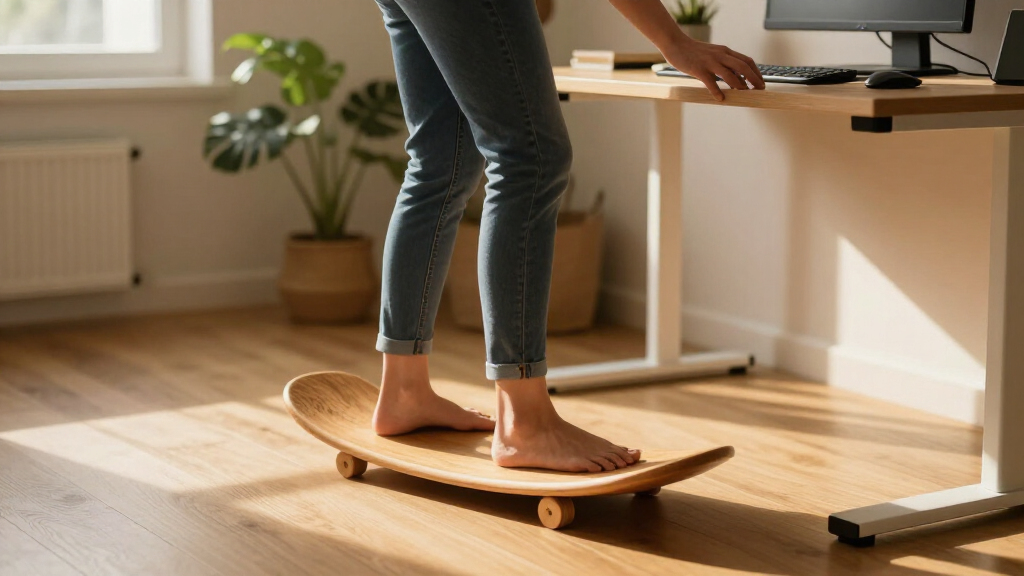
Standing desk balance boards turn a static standing desk into a low-effort movement station, keeping your legs and core lightly engaged while you type, take calls, or read. Across this lineup, the FluidStance Plane stands out as the best overall pick for its exceptionally smooth, controlled rocking motion and premium steel-and-rubber build that stays quiet under an office desk. If budget leads your decision, the Trobing Standing Desk Mat Balance Board delivers surprising stability for the price, while the UPLIFT Desk Motion-X Bamboo earns the premium spot with a wide, natural bamboo deck that pairs beautifully with high-end desks. The core tradeoff in this category is simple: smoother, quieter motion generally costs more, while cheaper boards often feel stiffer or slide on hard floors. Read on for the full breakdown, including which boards suit beginners and which ones demand real balance skills.

Get comfort and recovery gear delivered free — and shop member deals
- Fast, free delivery on millions of items
- Access to Prime Big Deal Days deals on October 6–7
- Prime Video, Amazon Music and more included
Complete the kit

Key Takeaways
- Motion quality separated the top picks more than any other factor — the FluidStance Plane and UPLIFT Motion-X deliver a fluid, dampened rock you can sustain all workday, while budget boards like the Zealtop rocker force chunkier, more tiring movements.
- The Ergo Collect 2-in-1 and FEZIBO large boards show that convertible mat-plus-rocker designs are the smartest value play if you alternate between standing and leaning throughout the day.
- Full 360° boards like the Whirly Board are fitness tools first — genuinely great for training, but too demanding for steady typing at a desk.
- Board width mattered more than expected: decks under 22 inches forced frequent stance corrections, while the 27-inch UPLIFT and large FEZIBO allowed near-effortless all-day standing.
- Floor protection is the most common weak point — several budget boards slide or scuff hard floors, so a grippy base matters as much as the deck itself.
| Trobing Standing Desk Mat Balance Board | 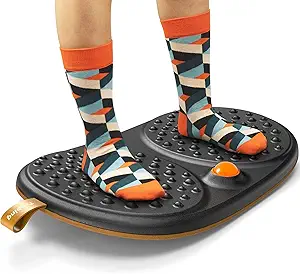 | Best Cushioned Comfort | Material: 90% sponge, 10% rubber | Maximum Weight Capacity: 350 lbs | Tilt Angle: 8.2° | VIEW LATEST PRICE | See Our Full Breakdown |
| Zealtop Standing Desk Balance Board, Anti-Fatigue Rocker Mat, Large |  | Best Budget-Friendly Pick | Brand: Zealtop | Model: ZT-Comfort Floor Mat | Size: Large | VIEW LATEST PRICE | See Our Full Breakdown |
| Ergo Collect 2-in-1 Standing Desk Balance Board and Foot Mat, Black |  | Best Multi-Function Design | Color: Black | Functions: Balance board, calf stretch board, and massage mat | Movement: 360-degree micro-movement | VIEW LATEST PRICE | See Our Full Breakdown |
| FEZIBO Standing Desk Balance Board, Large, Obsidian Black |  | Best for Movement Plus Exercise | Color: Obsidian Black | Size: Large | Tilt Angle: 8.5° | VIEW LATEST PRICE | See Our Full Breakdown |
| Gaiam Evolve Balance Board for Standing Desks |  | Best for Gentle All-Day Rocking | Weight Capacity: 250 pounds | Surface: Non-slip honeycomb texture | Movement Type: Gentle rocker motion | VIEW LATEST PRICE | See Our Full Breakdown |
| FluidStance Plane Balance Board for Standing Desks |  | Best Eco-Friendly Pick | Product type: Balance board | Use: Standing desk movement | Deck material: 100% recycled low-emitting tire treads | VIEW LATEST PRICE | See Our Full Breakdown |
| UPLIFT Desk Motion-X Bamboo Balance Board, 27-Inch |  | Best Premium Build | Dimensions: 27 x 12.5 inches | Deck thickness: 5/8 inch | Material: Sustainably sourced bamboo | VIEW LATEST PRICE | See Our Full Breakdown |
| FEZIBO Standing Desk Balance Board, Obsidian Black |  | Best Dual-Use for Work and Workouts | Color: Obsidian Black | Tilt angle: 8.5° | Movement: 360-degree swing | VIEW LATEST PRICE | See Our Full Breakdown |
| Wooden Balance Board for Fitness and Standing Desk Training |  | Best for High Weight Capacity | Brand: KFURNIKN | Material: Birch wood | Dimensions: 27.5 × 11.8 inches | VIEW LATEST PRICE | See Our Full Breakdown |
| Ergohead Standing Desk Anti-Fatigue Balance Board with Massage Marbles |  | Best for Foot Fatigue Relief | Rotation: 360 degrees | Maximum tilt: 8 degrees | Features: Massage balls and marbles on a track | VIEW LATEST PRICE | See Our Full Breakdown |
| Whirly Board Wide 360° Balance Board |  | Best for Dynamic Movement and Cross-Training | Deck width: 10 inches | Deck material: Canadian maple | Motion: 360-degree spinning, rocking, and tilting | VIEW LATEST PRICE | See Our Full Breakdown |
More Details on Our Top Picks
Trobing Standing Desk Mat Balance Board
Most boards in this category ask you to stand on a rigid deck, but the Trobing takes a softer approach with a sponge-and-rubber cushioned surface that doubles as an anti-fatigue mat. If your feet ache after long standing sessions, this feels noticeably kinder than the harder decks of the Gaiam Evolve or the FEZIBO board. The 8.2° tilt keeps movement subtle rather than demanding, and the built-in 360° massage ball is a genuine differentiator for anyone who works barefoot or in socks at home. The tradeoff: cushioning blunts the balance challenge. Compared with the Ergo Collect, you get less of a workout and fewer configurations. The listing also shows conflicting warranty durations, which makes long-term support a bit of a gamble.
Pros:- Cushioned surface reduces foot fatigue during long sessions
- Subtle 8.2° tilt suits all-day desk use
- Built-in rotating massage ball eases foot tension
- Waterproof, stain-resistant surface wipes clean easily
Cons:- Cushioning softens the balance challenge compared to rigid boards
- Conflicting 2-year and 5-year warranty claims create uncertainty
Best for: Home office workers who want gentle movement plus soft underfoot comfort during long standing shifts
Not ideal for: Buyers chasing a real stability challenge — the soft surface dampens the wobble effect
- Material:90% sponge, 10% rubber
- Maximum Weight Capacity:350 lbs
- Tilt Angle:8.2°
- Foot Massage Feature:Built-in 360° rotating massage ball
- Base:Non-slip
- Surface:Waterproof and stain-resistant
- Warranty:2 years stated; description also mentions 5 years
Our verdict“Choose the Trobing if all-day comfort matters more to you than a serious balance workout.”
Zealtop Standing Desk Balance Board, Anti-Fatigue Rocker Mat, Large
The Zealtop covers the essentials — gentle rocking, massage points, grip — without asking you to pay for extras you may never use. Where the Ergo Collect 2-in-1 adds stretching and massage-mat functions, Zealtop keeps things simple: a side-to-side rocker with rubber bumpers that stop each tilt before it becomes disruptive mid-email. Those bumpers matter more than they sound, since unbuffered boards like the Whirly Board demand constant attention. Its lightweight build also makes it easy to shuttle between office and home, something heavier wooden decks can’t match. The honest downside is vagueness: no published dimensions or weight means you’re guessing whether it fits your stance width, and the movement is fixed to one axis, so it won’t challenge you in multiple planes.
Pros:- Gentle side-to-side rocking engages core without distraction
- Rubber bumpers create controlled stopping points
- Massage points promote circulation during long standing periods
- Lightweight and easy to carry between locations
Cons:- No published dimensions or product weight
- Single-axis movement limits the balance challenge
Best for: First-time balance board buyers who want low-risk movement at their desk without a premium price
Not ideal for: Tall or wide-stance users who need guaranteed deck space — no dimensions are published
- Brand:Zealtop
- Model:ZT-Comfort Floor Mat
- Size:Large
- Intended Use:Standing desks, home, and office
- Features:Massage points, rubber bumpers, grip surface
- Movement Type:Side-to-side rocking
- Age Range:Adult
Our verdict“A sensible entry point if you want desk movement basics covered and nothing more.”
Ergo Collect 2-in-1 Standing Desk Balance Board and Foot Mat, Black
This is the Swiss Army knife of the lineup. The Ergo Collect works as a balance board, a calf stretch board, and a flip-side massage mat, with a solid wood core sandwiched between PU layers — a more premium construction than the sponge-based Trobing. The built-in leather handle is a small touch that pays off if you move between rooms or tuck it away at day’s end, something neither the FEZIBO nor the Zealtop offers. Its 360-degree micro-movement also engages more muscles than the single-axis Zealtop rocker. The cost of that versatility is complexity: three functions means none are specialized, and stretch-board fans may find the angle less aggressive than a dedicated slant board. Missing dimensions also make fit a gamble for larger stances.
Pros:- Three functions in one: balance, stretch, and massage mat
- Solid wood core with dual PU layers for durability
- Anti-slip grip on both sides
- Leather carry handle for portability
Cons:- Multi-function design means no single function is best-in-class
- No published dimensions or product weight
Best for: Desk workers who want movement, calf stretching, and foot massage from one purchase
Not ideal for: Buyers who want one job done perfectly — each function is decent but none are specialized
- Color:Black
- Functions:Balance board, calf stretch board, and massage mat
- Movement:360-degree micro-movement
- Materials:Solid wood core with dual PU outer layers
- Weight Capacity:350 lbs (158 kg)
- Grip:Anti-slip on both sides
- Handle:Built-in leather handle
Our verdict“Pick the Ergo Collect if you’d rather own one versatile board than three single-purpose accessories.”
FEZIBO Standing Desk Balance Board, Large, Obsidian Black
What separates the FEZIBO from every cushion-and-rocker option here is that it’s built for actual workouts. The 8.5° tilt and grippy deck support squats, planks, and push-ups, letting one board pull double duty between desk hours and exercise breaks. Compared with the Gaiam Evolve, which is purely a standing accessory, the FEZIBO gives you a reason to step away from the monitor and move. The grippy surface holds firm during both typing and training, and the compact frame stores easily under a desk. Be realistic about limits, though: at 320 lbs capacity, it trails the Trobing and Ergo Collect’s 350 lbs, and its narrower focus means no massage points or cushioning for tired feet. It also tilts only front-to-back, so multi-directional challenge seekers should look elsewhere.
Pros:- Doubles as a platform for squats, planks, and push-ups
- Grippy surface stays secure during exercise and typing
- Stable 8.5° tilt is manageable for long sessions
- Compact and easy to store or move
Cons:- 320 lb capacity is lower than similarly priced boards
- No massage or cushioning features for pure comfort seekers
Best for: People who want to sneak bodyweight exercises between meetings and standing work
Not ideal for: Buyers over 320 lbs or those wanting cushioned comfort and massage features
- Color:Obsidian Black
- Size:Large
- Tilt Angle:8.5°
- Weight Capacity:320 lbs
- Use:Standing desk movement and exercise
- Exercise Support:Squats, planks, push-ups
- Surface:Grippy texture
Our verdict“The FEZIBO makes sense if your balance board should break a sweat, not just wobble.”
Gaiam Evolve Balance Board for Standing Desks
The Gaiam Evolve earns its place by being the least demanding board to live with. Its ergonomic rocker design produces subtle movement that engages the back, core, legs, and ankles without demanding the focus that a 360° spinner like the Whirly Board requires — you can take calls and type while barely thinking about it. The non-slip honeycomb surface also works on both hard floors and carpet, a flexibility the harder-edged UPLIFT Motion-X doesn’t advertise as clearly. Its pedigree in physical therapy settings makes it a safe entry for people easing into standing work or recovering from injury. The compromises are real, though: the 250 lb weight limit is the lowest in this roundup, and there’s no cushioning or massage function — the Trobing is the better pick for pure underfoot comfort.
Pros:- Subtle rocking engages stabilizing muscles without distraction
- Non-slip honeycomb surface works on hard floors and carpet
- Ergonomic design suits all-day desk use
- Trusted format for physical therapy and low-impact exercise
Cons:- 250 lb weight capacity is the lowest among comparable boards
- No cushioning or massage features for foot comfort
Best for: Office workers and physical therapy users who want barely-noticeable movement on any floor surface
Not ideal for: Users over 250 lbs or anyone wanting cushioning, massage points, or exercise features
- Weight Capacity:250 pounds
- Surface:Non-slip honeycomb texture
- Movement Type:Gentle rocker motion
- Floor Compatibility:Hard floors and carpet
- Use:Standing desks, home office, physical therapy, and exercise
- Muscle Engagement:Back, core, legs, and ankles
Our verdict“The Gaiam Evolve is the set-and-forget choice for quiet, low-effort movement under a standing desk.”
FluidStance Plane Balance Board for Standing Desks
The FluidStance Plane stands out for its sustainability story: a deck made from 100% recycled tire treads sitting on a recycled plastic base, assembled in the USA. Compared with the FEZIBO Obsidian Black, which is built purely for function, the Plane appeals to buyers who care where their materials come from. Its rubber bumpers act as stopping points, which translates into a more predictable rocking range — helpful if you’re answering emails and don’t want a sudden lurch. The tire-tread deck is genuinely grippy, a step up in traction over smoother wooden options like the KFURNIKN birch board. The tradeoff is that FluidStance doesn’t publish dimensions or a weight capacity, so larger or taller users are buying on faith. It’s also compact and light, which suits shared workspaces more than intense training.
Pros:- Deck made from 100% recycled tire treads with a recycled plastic base
- Grippy surface plus rubber bumpers that limit tilt for predictable motion
- Compact and lightweight enough to carry between rooms or offices
- Assembled in the USA with a documented materials story
Cons:- No published dimensions or weight capacity, which leaves larger users guessing
- Wobble-style motion takes adjustment before it feels natural while typing
Best for: Eco-conscious desk workers who want subtle movement from a brand with a transparent recycled-materials build
Not ideal for: Buyers who need confirmed dimensions and a rated weight capacity before purchasing
- Product type:Balance board
- Use:Standing desk movement
- Deck material:100% recycled low-emitting tire treads
- Base material:Recycled plastic
- Safety features:Grip surface and rubber bumpers
- Manufacturing:Assembled in the USA
Our verdict“A strong fit for sustainability-minded standing desk users who value controlled, subtle motion over workout versatility.”
UPLIFT Desk Motion-X Bamboo Balance Board, 27-Inch
If long-term ownership matters more than upfront savings, the UPLIFT Desk Motion-X makes the most sense for you. Its 15-year warranty signals a confidence no other board in this lineup matches — the KFURNIKN and Ergohead boards don’t list any warranty at all. The 27 x 12.5-inch bamboo deck gives you room to shift your stance naturally, where smaller wobble boards like the FluidStance Plane keep you pinned in one spot. Rock, tilt, and swivel motions let your posture change throughout the day rather than repeating a single rocking arc. The compromises are real, though: the cushioned motion mat is sold separately, and this board is tuned for gentle active standing — it won’t double as the workout platform the FEZIBO Obsidian Black can.
Pros:- 15-year warranty coverage, the strongest guarantee in this roundup
- Spacious 27 x 12.5-inch bamboo deck supports a natural, shifting stance
- Multidirectional rocking, tilting, and swiveling for varied movement
- Rubber bumpers control motion and protect hard floors
Cons:- Motion board mat for extra cushioning costs extra
- Designed for gentle movement, not exercise or intense training
Best for: Professionals investing in a permanent standing desk setup who want a spacious platform and serious warranty backing
Not ideal for: Buyers who want an all-in-one package or a board that doubles as a workout tool
- Dimensions:27 x 12.5 inches
- Deck thickness:5/8 inch
- Material:Sustainably sourced bamboo
- Weight capacity:250 lbs
- Warranty coverage:15 years
- Base:Molded base with rubber bumpers
- Intended use:Active standing at a desk
Our verdict“The pick for buyers who see a balance board as a decade-long desk companion rather than an experiment.”
FEZIBO Standing Desk Balance Board, Obsidian Black
The FEZIBO Obsidian Black earns its spot by refusing to be just a desk accessory. Its 360-degree swing and 8.5° tilt keep your legs and core engaged during work hours, and the same platform handles squats, planks, and push-ups when you step away from the screen. That versatility is something the UPLIFT Motion-X, with its gentle-motion design, deliberately avoids. The 320-pound weight capacity is the highest confirmed rating among the boards here that actually publish one, making it a safer choice for larger users than the FluidStance Plane, which lists no capacity at all. On the downside, the 360-degree swing is livelier than a simple rocker, so expect a wobbly first week while typing. FEZIBO also skips dimensions and product weight, which makes storage planning a guessing game.
Pros:- Doubles as an exercise platform for squats, planks, and push-ups
- 320-pound weight capacity, the highest confirmed rating in this batch
- 360-degree swing with 8.5° tilt for continuous micro-movement
- Grip surface and steady design support confident footing
Cons:- Lively 360-degree motion takes adjustment while working
- No dimensions or product weight listed, complicating storage plans
Best for: Desk workers who want one board that handles both active standing and bodyweight exercises between meetings
Not ideal for: Anyone wanting a calm, minimal-motion platform for focused typing sessions
- Color:Obsidian Black
- Tilt angle:8.5°
- Movement:360-degree swing
- Weight capacity:320 pounds
- Use:Standing desk balance board and exercise board
- Surface:Grip surface
Our verdict“The best two-for-one choice if your balance board needs to survive both conference calls and workout breaks.”
Wooden Balance Board for Fitness and Standing Desk Training
This KFURNIKN birch board leads the roundup on raw capacity: rated for 440 pounds, it comfortably outguns the FEZIBO Obsidian Black’s 320 pounds and dwarfs the UPLIFT Motion-X’s 250-pound limit. For heavier users who’ve been shut out of most balance boards, that number alone justifies its place here. The curved rocker base with flexible slats supports twisting, backward rocking, and dynamic swaying, and the polished birch edges feel finished rather than rough. Its physical-therapy framing also makes it a fit for rehab-style balance training, a use case the Ergohead board only gestures at. The tradeoffs: a curved rocker with this range of motion demands real coordination, so true beginners may find it twitchy. It’s also a newer product with very limited customer feedback, so durability over years is unproven compared with established names like FluidStance.
Pros:- 440-pound maximum weight rating, the highest in this roundup
- Reinforced birch wood construction with polished, splinter-free edges
- Supports twisting, backward rocking, and 360° dynamic swaying
- Versatile enough for home fitness, office standing, and physical therapy
Cons:- Requires solid balance and coordination to use safely
- Very limited customer feedback, so long-term durability is unproven
Best for: Larger-framed users and physical therapy patients who need a 440-pound rating and multidirectional training motion
Not ideal for: Complete balance beginners who would be safer on a bumper-limited board like the FluidStance Plane
- Brand:KFURNIKN
- Material:Birch wood
- Dimensions:27.5 × 11.8 inches
- Maximum weight recommendation:440 pounds
- Movements:Twisting, flexibility training, backward rocking, dynamic swaying
- Age range:Adult
- Color:Wood
Our verdict“The clear choice for heavier users or rehab training, provided you already have decent balance confidence.”
Ergohead Standing Desk Anti-Fatigue Balance Board with Massage Marbles
The Ergohead board attacks a problem the others ignore: aching feet. Its massage balls and marbles glide along a track underfoot, stimulating your soles while the board rotates 360 degrees and tilts up to 8 degrees. No other board in this roundup offers anything comparable — the FEZIBO Obsidian Black moves similarly but gives you a plain grip surface. If you stand for long stretches and your arches pay for it, this is the differentiator that matters. Compared with the KFURNIKN’s 8-plus degree dynamic rocking, the Ergohead’s gentle 8-degree tilt is calmer and better suited to focused work. The gaps are familiar, though: no dimensions and no weight capacity are published, which puts it behind the FEZIBO and KFURNIKN on buyer confidence. The massage track also means an uneven standing surface, which some users will find distracting rather than soothing.
Pros:- Massage balls and marbles actively stimulate the soles during standing
- 360-degree rotation with a gentle 8-degree tilt suits focused work
- Doubles as a balance exercise tool for home or gym use
- Works in office, kitchen, and standing desk settings
Cons:- Uneven massage surface underfoot can feel distracting during concentrated tasks
- No dimensions or weight capacity published
Best for: Standing desk workers whose feet tire easily and want sole stimulation built into their movement routine
Not ideal for: Buyers who need a flat, even standing surface or confirmed weight capacity specs
- Rotation:360 degrees
- Maximum tilt:8 degrees
- Features:Massage balls and marbles on a track
- Suggested uses:Standing desk, office, home, kitchen, and gym
- Board type:Wooden wobble board
- Movement style:Gentle multidirectional balancing
Our verdict“A niche but worthwhile pick for anyone whose main standing-desk complaint is tired, achy feet rather than boredom.”
Whirly Board Wide 360° Balance Board
Most balance boards in this roundup restrict you to a gentle forward-and-back rock, but the Whirly Board Wide is built for full 360-degree motion. Its three semi-spherical balance points let you spin, tilt, and rock in any direction, which changes what the board is for: compared with the Gaiam Evolve or the Zealtop rocker mat, both of which favor subtle, desk-friendly movement, this one doubles as a genuine training tool for core work, board sports practice, and rehab exercises. The 10-inch Canadian maple deck feels like a skateboard deck rather than an office accessory, and it holds up to real workouts. The tradeoff is steepness: without the optional stabilizing ring (sold separately) or a wall to hold onto, beginners will find it twitchy while typing, and it needs a mat on hard floors.
Pros:- Full 360-degree spinning, rocking, and tilting for varied movement
- Durable 10-inch Canadian maple deck suitable for kids and adults
- Doubles as a fitness, sports-training, and rehab tool beyond desk use
- Compact and easy to move between home office and workout space
Cons:- Too advanced for beginners without support or the separately sold stabilizing ring
- Requires a mat on slippery floors, which is not included
Best for: Active standers who want one board for desk work, fitness training, and board-sports practice
Not ideal for: Desk workers who mainly want passive micro-movement while focused on a screen — the 360-degree motion demands attention and balance skill
- Deck width:10 inches
- Deck material:Canadian maple
- Motion:360-degree spinning, rocking, and tilting
- Balance points:Three semi-spherical points
- Stabilizing ring:Optional; sold separately
- Intended uses:Active standing, core and balance training, sports practice, rehabilitation
- Floor requirement:Mat required on slippery floors (sold separately)
Our verdict“Buy this if you want a balance board that trains real athleticism at your desk, not just wobble — but budget for the stabilizing ring if you’re new to balance work.”
How We Picked
My ranking logic starts with the question that actually matters at a desk: can you work while standing on it? I evaluated each board on motion quality — whether the rocking or tilting feels smooth and dampened or jerky and fatiguing — because a board you have to think about defeats the purpose of passive movement while typing. From there, I weighed build quality (deck materials, weight capacity, base grip, and noise levels), stance comfort (deck width and how long you can stand without repositioning), and versatility for buyers who also want a mat, massager, or fitness tool in one purchase.
Boards ranked higher when they balanced three things at once: enough instability to engage your legs, enough stability to type accurately, and a base that stays put on both carpet and hardwood. Price influenced placement only through value — a cheaper board that does its core job well beat an expensive one with gimmicks. Finally, I favored boards suited to real workdays: all-day standing comfort carried more weight than athletic challenge, which is why pure fitness boards landed lower despite being excellent at their actual job.
Factors to Consider When Choosing Standing Desk Balance Boards
Before choosing a board, it helps to understand what actually separates a great standing desk balance board from a frustrating one. These are the factors that shaped my rankings — and the mistakes that send most boards back.Motion Type: Rocker, Wobble, or Full 360°
The biggest mistake buyers make is assuming all balance boards move the same way. Rocker and wobble boards (like the FluidStance, FEZIBO, and Ergo Collect models) tilt along one or two axes with a limited range, which keeps your legs moving without demanding constant attention — this is the right choice for desk work. Full 360° boards like the Whirly Board roll in every direction, which is excellent for athletic training but genuinely hard to pair with typing or mouse work. A good sanity check before buying: if you cannot stand on the board with your eyes closed and a coffee in hand, it is probably too aggressive for an eight-hour workday. Many buyers end up owning both types — a milder board for work and a 360° board for workouts — rather than forcing one board to do two jobs poorly.
Deck Size and Stance Width
Deck dimensions matter more than most spec sheets suggest. Boards under about 22 inches wide force you into a narrow stance, which sounds minor but leads to constant micro-adjustments, ankle fatigue, and eventually abandoning the board entirely. Wider decks in the 26–30 inch range let you shift your stance naturally throughout the day, which is closer to how humans actually stand when not locked in place. Length also affects shoe choice — a shorter board may only accommodate one foot position, which becomes uncomfortable in dress shoes with rigid soles. If you wear a shoe size above 11 or simply stand for long stretches, prioritize width over every other spec except motion quality. Tall and broad-framed users should treat a large deck as non-negotiable rather than a nice-to-have.
Base Grip and Floor Protection
The most common complaint across this entire category is not the board itself — it is the base sliding on hardwood or tile. A board that creeps across the floor every few minutes breaks your concentration and can scratch soft flooring. Look for full rubber or high-friction polymer bases rather than hard plastic, and check whether the base is one solid piece or attached with adhesive that can peel over time. Carpet changes the equation: a grippy base designed for hardwood can feel dead and unresponsive on thick carpet, dampening the motion you paid for. If your workspace has mixed flooring, the safest bet is a board with a replaceable or very tall base. This is also where the price gap between budget and premium boards shows up most clearly in daily use.
Noise Level in Shared Spaces
If you work near others — an open office, a shared home office, or on calls all day — noise becomes a deciding factor. Hollow plastic decks amplify every weight shift into a hollow thump, while solid wood or bamboo decks with rubber contact points stay nearly silent. Rocker boards with hard stops at the end of their tilt range can produce a clunk when you overshoot, which gets old fast on a quiet conference call. Fluid, dampened motion is not just a comfort feature; it is what allows you to use the board during meetings without self-consciousness. Read product descriptions for terms like ‘quiet’ or ‘dampened’ and treat their absence as a yellow flag. In my rankings, noise complaints pushed otherwise solid boards below quieter competitors.
Weight Capacity and Build Materials
Weight ratings on balance boards deserve more scrutiny than they usually get, because a board at the top of its limit flexes, wobbles unpredictably, and wears out its base faster. Steel and multi-ply bamboo decks hold their stiffness over years, while thin molded boards can develop a permanent sag or crack at stress points. If you are above 220 pounds or plan to stand with a heavy backpack or weighted vest, choose a board rated well beyond your weight — ideally with at least 30 percent headroom. Also check how the deck surface handles sweat and shoe scuffs, since textured surfaces wear better but can feel rough in socks. Build quality is the main reason to pay more in this category: the premium boards in this lineup are bought once and used for years, while the cheapest ones are often replaced within a year.
Multifunction Boards: When 2-in-1 Makes Sense
Several boards in this roundup double as anti-fatigue mats or massage surfaces, and that versatility is genuinely valuable — for the right buyer. If you alternate between standing, sitting, and leaning against your desk, a convertible mat-and-rocker means one purchase covers your whole day instead of cluttering the floor with two items. The tradeoff is that 2-in-1 designs compromise on both modes: the rocking motion is usually milder than a dedicated board, and the mat side is firmer than a pure gel mat. Massage-surface boards with textured marbles or bumps offer short-term relief but can be uncomfortable in thin socks or bare feet over a full day. My advice: choose multifunction only if you genuinely rotate positions hourly. If you stand most of the day, a dedicated board does its single job noticeably better.
Frequently Asked Questions
Can I actually type and work productively while standing on a balance board?
Yes, but only on boards with limited, dampened motion — which is exactly why I ranked rocker and wobble boards above full 360° models. A quality rocker like the FluidStance Plane or UPLIFT Motion-X keeps your body swaying gently while your hands stay steady enough for accurate typing. Boards with aggressive, multidirectional movement force your core to work overtime, and that muscular tension travels up to your shoulders and affects mouse precision. A practical approach for beginners: start with the board for phone calls and reading, then gradually shift typing tasks onto it as your balance adapts. Most people reach comfortable all-day use within one to two weeks, but only if the board’s motion range is modest to begin with.
Is a balance board better than a plain anti-fatigue mat for a standing desk?
They solve different problems, and many desk workers end up using both. An anti-fatigue mat encourages subtle weight shifting through its cushioning, which reduces foot and lower-back fatigue but barely engages your muscles. A balance board actively recruits your calves, quads, and core, promoting more circulation and movement — but it also demands more from your body, especially early on. If you stand for very long stretches or have joint sensitivity, a mat is the gentler daily choice. If your goal is combatting the stiffness of standing still, a board does that job better. The 2-in-1 boards in this roundup, like the Ergo Collect, exist precisely because neither option wins outright.
Will a balance board damage my hardwood floors or slide around?
It depends almost entirely on the base material. Boards with full rubber or high-friction polymer bases grip hardwood and tile well and protect the finish; boards with hard plastic or partially rubberized bases can creep, squeak, or leave scuff marks over time. Sliding tends to worsen as the base collects dust, so occasional wiping helps maintain grip. On thick carpet, the concern flips: instead of sliding, most boards lose responsiveness because the carpet absorbs the motion, making a rockered base with more height a better fit there. If your floors are a concern, the premium boards with solid rubber bases — the FluidStance and UPLIFT models — are the safest choices, and a thin, dense rug pad under the board solves most carpet issues.
How long should I stand on a balance board each day when starting out?
Treat it like any new physical activity and ramp up gradually — most people overdo it in week one and then shelve the board. Start with 20 to 30 minutes per day split into short sessions, ideally during low-focus tasks like calls or email. Your calves and stabilizer muscles will fatigue faster than you expect, and that fatigue is your cue to step off, not push through. Add roughly 15 minutes per week until you reach two to three hours of accumulated board time daily, which is the sweet spot for movement benefits without leg exhaustion. Full-day standing on a board is achievable for most people, but it typically takes a month of consistent use, and even then most users benefit from rotating between the board, flat floor, and sitting.
Are the more expensive balance boards actually worth the extra money?
The honest answer: the difference between a $40 board and a premium one is real, but the difference between mid-range and premium is smaller. Budget boards deliver the basic rocking motion, and for light users they are perfectly serviceable — the Trobing proves that. Where premium boards justify the cost is in motion smoothness, noise, and durability: dampened, fluid rocking you can sustain for hours, near-silent operation for shared spaces, and bases that keep their grip for years instead of months. If you work from home, use the board daily, and take calls on it, the premium tier pays off. If you plan to stand on it 45 minutes a day, the mid-range boards give you 90 percent of the experience at a fraction of the cost.
Conclusion
The right standing desk balance board depends less on which one is ‘best’ and more on how you actually work. For most buyers, the FluidStance Plane is my best overall pick — its smooth, quiet, dampened motion is the closest thing in this lineup to a board you forget you are standing on. For best value, the Trobing Standing Desk Mat Balance Board covers the fundamentals well, while the Ergo Collect 2-in-1 is the smarter value choice if you also want an anti-fatigue mat in the same footprint. At the premium end, the UPLIFT Desk Motion-X Bamboo pairs a wide, elegant bamboo deck with refined motion, making it the natural match for a high-end desk setup. Beginners should start with the FEZIBO large board or the Gaiam Evolve, both of which offer gentle, confidence-building tilt before you progress to more demanding movement. For specific needs: the Whirly Board is the pick for fitness-focused users who want genuine balance training, the Ergohead with massage marbles suits anyone who stands barefoot or in socks and wants foot relief built in, and the Wooden Balance Board for Fitness and Training works for buyers blending workouts with desk use. Whatever you choose, size the board to your stance, match the base to your floor, and start with short sessions — the best board is the one you are still standing on six months from now.
Fall Picks
fall essentials
As an affiliate, we earn on qualifying purchases.