
TL;DR

Get comfort and recovery gear delivered free with Prime
- Fast, free delivery on millions of items
- Prime Video, Amazon Music and more included
- Member-only deals all year
A Fit&Well writer reported that practicing offset child’s pose for two weeks coincided with improved mobility and much less mid-back pain. The account is a personal experiment, not a controlled study, and does not establish that the stretch will relieve pain for others.
A Fit&Well writer said two weeks of offset child’s pose coincided with a marked improvement in their mid-back pain, which had flared when lifting their toddler-aged son. The account describes one person’s experience, not evidence from a clinical trial, so it cannot show whether the stretch caused the improvement or would help others.
The writer, who identified themself as a certified personal trainer, began the routine after noticing stiffness and nagging pain in their mid-back. They chose the stretch because it was gentle and easy to do, and practiced it daily for two weeks. At first, they held the position for 30 seconds on each side; as it became more comfortable, they increased the holds, reaching 60 seconds per side during the final three days.
The writer practiced the stretch twice a day at first, then reduced it to once a day after their back began to feel better around the midpoint of the experiment. They said they noticed greater range of motion within a few days and that, after nine days, their mid-back pain was “pretty much gone.” They also reported sitting more comfortably, finding it easier to carry their son, and lifting heavier weights during chest presses. These are the writer’s observations, not independently measured outcomes.
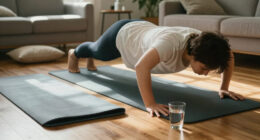
Physical therapist Dr. Michael Nula described the movement as stretching muscles along the mid and lower back while the hips and knees move through a comfortable range. He said it may help relieve muscle tension and reduce joint compression. For the offset variation, the practitioner moves from hands and knees, sits the hips back toward the heels, and reaches both arms to one side before repeating on the other. The source recommends 30 to 60 seconds per side and cautions against forcing the position.
What One Stretching Trial Can Show
The report offers a practical example of how a person incorporated a brief mobility exercise into a routine and tracked changes in stiffness and discomfort. Its main value is as an individual account: it gives readers details about the stretch, how long the writer held it, and how they adjusted the routine as their mobility changed.
But the result should not be read as proof that child’s pose treats mid-back pain. The experiment involved one person over two weeks, with no comparison group, clinical assessment, or standardized pain measurements described. The writer’s symptoms may have changed for other reasons, and the account cannot establish how common or lasting the improvement was. People with persistent or severe pain should not rely on this anecdote as a substitute for appropriate medical advice.
Products Worth Considering

Bose S1 Pro+ All-in-One PA Speaker

Levoit Vital 100S-P Air Purifier with Washable Pre-Filter

Shark HydroVac MessMaster Corded Wet Dry Vacuum and Mop (WD161)
As an affiliate, we earn on qualifying purchases.
How the Writer Adjusted the Stretch
The writer said their back discomfort flared when they lifted their young child and linked it to a recent lack of flexibility. They began with a relatively short hold on each side and extended the duration to 45 seconds after the stretch started feeling more comfortable. By the last three days, they were holding for a minute on each side. They also said focusing on slow, deep breaths helped them move further into the position.
Nula’s guidance in the report was to avoid forcing the pose. If the hips do not reach the heels, he suggested placing a pillow in the gap so the position suits the person’s available range. The report says the stretch may not be appropriate for everyone, particularly people with certain medical conditions or injuries, and advises consulting a physician if there are concerns about attempting it.
Limits of the Personal Result
The report does not provide clinical measurements of pain or mobility, a diagnosis for the writer’s symptoms, or a way to separate the stretch’s effects from other changes over the same period. It also does not say whether the improvement lasted after the two-week trial. No controlled research findings are presented in the source, so the account cannot establish that the stretch caused the change or predict its effects for other people.
The writer’s description of “pretty much gone” is a personal assessment, not a formal finding. The report also does not specify which medical conditions or injuries would make the pose unsuitable. Anyone uncertain about whether the movement is appropriate for them is advised in the source to consult a physician.
The Writer Plans Continued Practice
The writer said they intended to keep offset child’s pose in their routine several times a week, while acknowledging they might not practice it every day. The report does not describe a longer follow-up, so it is unknown whether the improvement continued or whether the writer’s routine changed afterward.
For readers considering the movement, the source describes starting with a comfortable range and short holds, then adjusting only if the position feels manageable. The writer and Nula’s comments do not replace individualized guidance, particularly for people with an injury, a medical condition, or ongoing pain.
Key Questions
What stretch did the Fit&Well writer try?
The writer practiced offset child’s pose, reaching both arms to one side while sitting the hips back, then repeating on the other side.
How long did the writer hold the stretch?
They began with 30 seconds per side, increased the hold as the position became more comfortable, and reached 60 seconds on each side during the final three days.
Does the report prove the stretch relieves mid-back pain?
No. It records one person’s experience and does not describe a controlled study or clinical measurements. It cannot establish that the stretch caused the improvement or that others will have the same result.
Is offset child’s pose suitable for everyone?
The report says people with certain injuries or medical conditions may need to avoid the position and advises consulting a physician if unsure. Nula also cautioned against forcing the stretch and suggested using a pillow if the hips do not comfortably reach the heels.
Source: fitandwell.com